
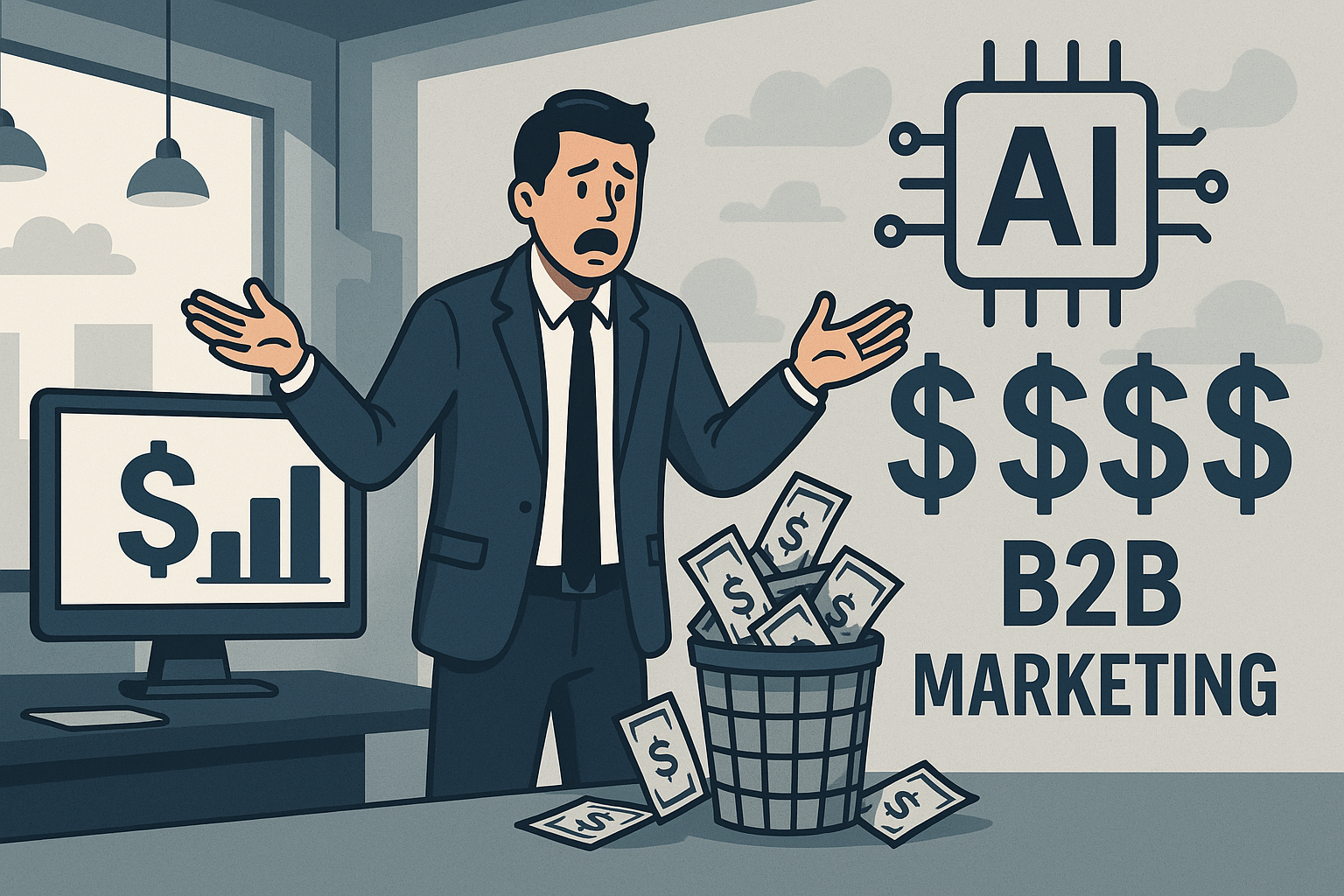
Google promised better results. Their senior strategist insisted: “Switch to Maximize Conversions.” So we did. Within two weeks, the client’s top-performing B2B campaign devolved into a sea of irrelevant clicks, bot traffic, and a mysterious category called “Other,” which quietly drained the budget with no accountability. This is what happens when AI optimization meets complex, high-ticket sales.
The Illusion of Intelligence: How Google’s AI Misfires in B2B
For advertisers selling $20,000+ industrial equipment, AI-powered bidding can feel like rolling the dice with thousand-dollar chips. In theory, Google’s “Maximize Conversions” strategy uses machine learning to optimize for leads. In reality, it often latches onto the first signal it finds, even if it is junk.
In our client’s case, the AI quickly “learned” that certain types of traffic—free email domains, foreign IPs, and meaningless form fills—converted. It didn’t matter that none of these led to qualified leads or sales. The conversion pixel fired, the algorithm smiled, and the budget evaporated.
This isn’t speculation. It’s the lived experience of many advertisers whose products aren’t impulse buys. When conversions require research, consultation, or involve multiple stakeholders, AI optimization based solely on form completions is fundamentally flawed.
The “Other” Problem: Where Budget Goes to Die
If you’ve run search campaigns on Google Ads, you’ve likely seen a line item in your search term report labeled “Other.” According to Google, these are clicks from terms that “weren’t searched by enough users to be listed individually.”
That sounds reasonable until you notice that some of these terms show zero impressions and zero clicks—yet still account for spend.
In this campaign, a significant portion of the budget went to these untraceable “Other” queries. This lack of transparency is especially concerning in high-ticket B2B sales, where each click might cost $20 to $50, and budgets are carefully allocated to avoid waste.
This is the black-box reality of AI bidding. You’re told it’s working, but the details are locked away, and when performance drops, the only feedback you get is, “Give it more time.”
Why AI Struggles with Long Sales Cycles
AI thrives on volume. It needs thousands of conversions to learn what works. But B2B equipment companies might close 10–20 sales a month—and that’s a good month. Each sale can involve weeks of back-and-forth, custom quoting, and stakeholder approvals.
AI can’t see that. It considers the form fill and thinks, “We nailed it.”
What it doesn’t see:
- If the lead had a real company domain
- If anyone followed up successfully
- If the sales team marked it as qualified
- If the person even answered the phone
The AI makes shallow guesses without those downstream signals fed back into the system. And when it guesses wrong, it doubles down.
The Feedback Loop from Hell
Here’s what typically happens:
- A few bad leads fill out your form.
- AI marks them as conversions.
- The algorithm begins by favoring similar traffic.
- Your CPL drops—but so does the quality of your leads.
- Budget shifts away from valuable audiences toward cheap clicks.
- Sales dry up.
By the time you notice, Google has “optimized” your budget into oblivion.
What Real Recovery Looks Like
The good news? You can recover. But not with more automation. You need a human strategy. Here’s what we did to stabilize performance:
- Stopped trusting the pixel alone. We reviewed every lead manually and began segmenting conversions by quality tier.
- Fed back real sales data. We used offline conversion imports to teach the AI what a real customer looks like.
- Disabled broad match expansion. Too many irrelevant terms were being pulled in under the guise of smart matching.
- Rebuilt campaigns with tighter intent signals. We focused on bottom-funnel queries and exact-match terms that have historically proven to convert.
- Redefined conversions. Form fills from free or foreign email domains no longer counted unless verified by the sales team.
Statistics That Should Worry You
- According to Juniper Research, advertisers are expected to lose over $100 billion to ad fraud in 2024—2025.
- A report from CHEQ found that 17% of all paid traffic is fake or invalid, including bots and fraudulent users.
- Google Performance Max has been widely criticized for its lack of transparency and for serving ads on placements that don’t meet advertiser expectations, including YouTube channels aimed at children.
Final Thoughts: AI Needs Adult Supervision
The promise of AI is seductive: flip the switch, and let the algorithm do the rest. However, AI cannot replace strategy if you sell high-ticket products to decision-makers. It can’t feel nuance. It doesn’t understand context. It doesn’t know that a form fill isn’t a deal.
If your campaigns have suddenly stopped performing, and you’re being told to “just give it more time,” it may be time for a reset.
Real marketing success isn’t automatic. It’s architected. And if you want your ad dollars to work harder, you need more than an innovative algorithm—you need a brilliant strategist.