
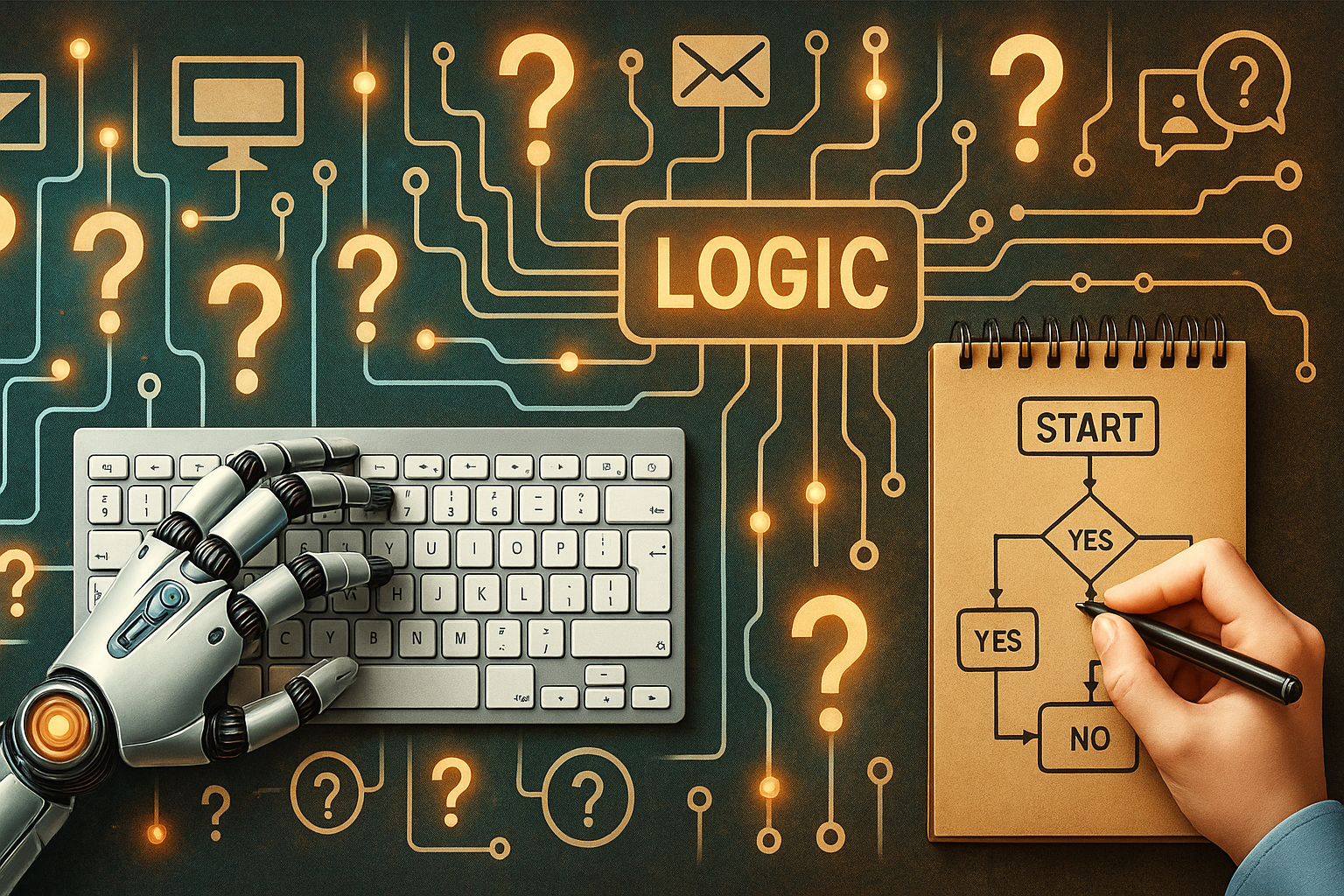
Before you automate with AI, automate with logic.
Most companies skip the simplest and most effective step: mapping their most common customer questions and providing clear, human-written answers.
1. 80% of Support Questions Are Predictable
Every company has a short list of repetitive, high-frequency questions that never change:
- “What’s the lead time?”
- “Can this machine cut metal?”
- “What power do I need for ¼-inch acrylic?”
- “Do you offer financing?”
- “Where can I get replacement parts?”
A well-structured decision tree or rule-based chatbot can answer all of these instantly, without AI.
Study Insight: Intercom found that 65% of customers prefer quick, accurate answers over “personalized” chatbot conversations. Simplicity beats simulation.
2. AI Chatbots Often Create Confusion, Not Clarity
AI is trained to sound confident, even when it’s wrong.
That’s dangerous in industries with safety, compliance, or warranty considerations.
“AI can handle knowns; humans must handle unknowns.”
When you let AI improvise, you introduce risk:
- Wrong specifications → liability
- Wrong pricing → lost trust
- Wrong troubleshooting → expensive damage
Logical scripts, on the other hand, always give the correct answer when the rules are correctly defined.
3. Predictability = Trust
B2B buyers aren’t looking for small talk; they’re looking for competence.
When your chatbot gives a clean, factual answer in 3 seconds, you’ve already proven your professionalism.
82% of B2B buyers say accuracy matters more than personalization in vendor communication (Demand Gen 2024).
AI makes guesses. Logic makes decisions.
4. AI Bots Require Huge Data (You Don’t Have It Yet)
AI only performs well when trained on thousands of consistent, contextual interactions.
Most small and mid-sized companies have a few hundred. That’s not enough to train a reliable model, so the AI will “hallucinate.”
Until you have a large, clean knowledge base, rule-based logic will always outperform AI in reliability.
5. Logic First = Strong Foundation for Later AI
Building a logical flowchart is not wasted effort; it’s training data for the future.
Start with:
- Your top 20–30 questions
- Conditional branching (“If non-metals → show CO₂ / If metal-processing → show Fiber”)
- Add escalation triggers (“Would you like to speak to a laser specialist?”)
Once you’ve gathered thousands of interactions, then, and only then, layer AI on top. At that point, it can learn from your real customer data rather than generic internet text.
6. Faster, Cheaper, and Easier to Maintain
Rule-based chatbots:
- Costs a fraction of AI systems
- Don’t require model retraining
- Never go “off-script” or deliver embarrassing answers
- Can be updated by your marketing or support team in minutes
Example:
A “If Question Contains → Respond With” structure in WPBot, Tidio, Crisp, or HubSpot’s native chat can handle 90% of customer needs without a single AI token burned.
7. The Strategic Message: “Get Human Before You Get Smart.”
AI should enhance an already solid, human-informed system—not replace it.
If your chatbot doesn’t yet reflect your company’s real expertise, automating it with AI only amplifies confusion.
Start simple:
- List your most common questions.
- Write the perfect human answer for each.
- Map logic-based pathways.
- Only after it works—add AI for nuance or follow-up.
⚙️ Example: “Logic First” Chatbot Flow
Visitor: “Can I cut metal with a CO₂ laser?”
Bot: “CO₂ lasers can engrave metal coatings and cut non-metals. If you primarily need to cut metal, you should use a fiber laser. Would you like to compare the two?”
→ Button: [Compare CO₂ vs Fiber] → Button: [Talk to a Specialist]
No hallucination. No wasted time. Just clarity.
8. Proof from Industry Studies
- Gartner (2025): 72% of customers prefer a structured, self-service experience to “conversational” AI that improvises.
- Harvard Business Review (2024): Human-supervised chatbots improved service efficiency by 20%, while unsupervised AI bots increased error rates by 37%.
- Intercom (2024): Only 25% of users would reuse an AI chatbot if they didn’t reach a clear resolution within 90 seconds.
✅ Bottom Line
“Don’t make AI your first chatbot—make it your reward for mastering logic.”
If you can’t answer your top 20 customer questions instantly, an “intelligent” chatbot won’t save you—it’ll just confuse faster.
Start with rules. Add AI later.
That’s how you build customer confidence and future-proof your automation.