
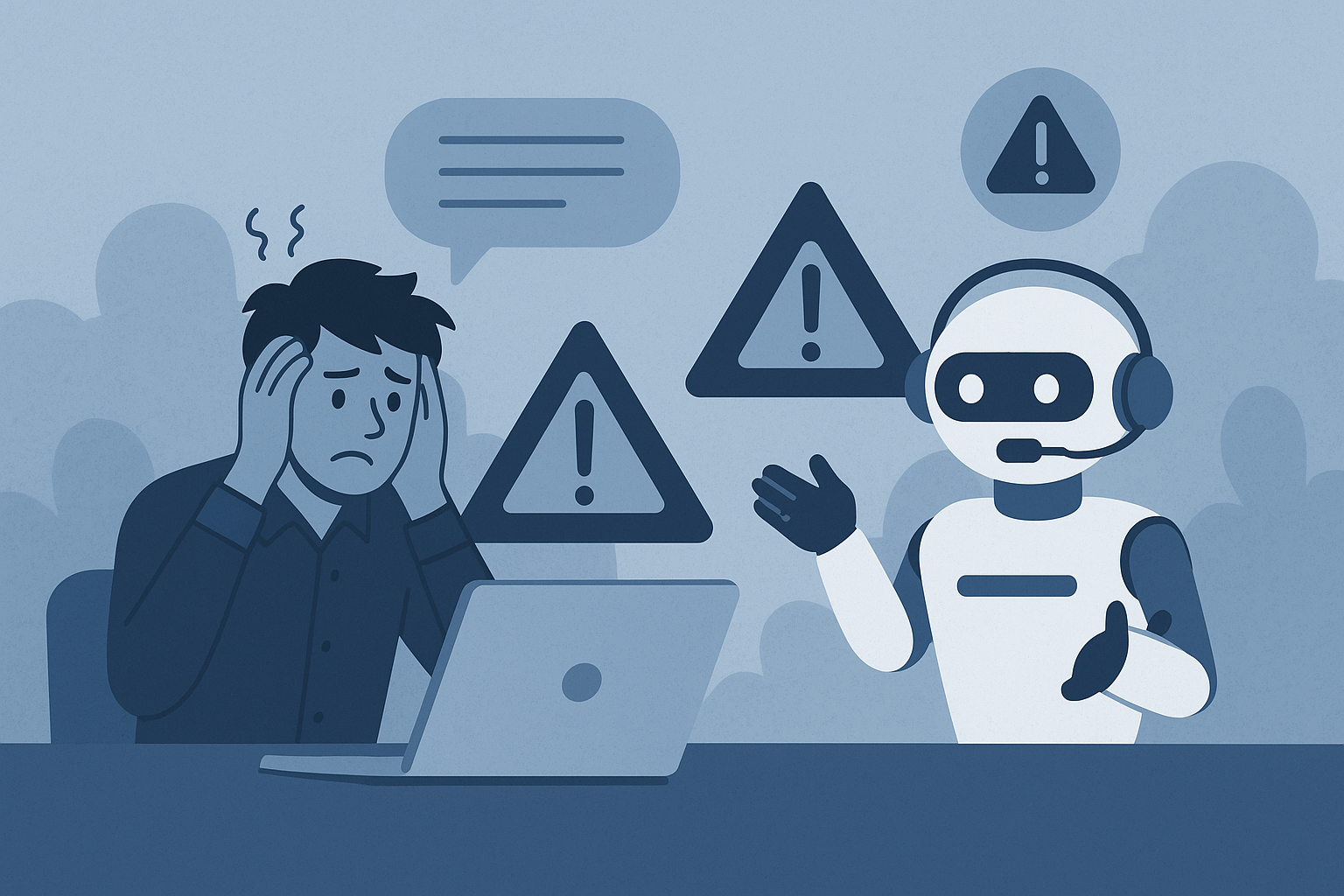
Artificial Intelligence has become the go-to solution for streamlining sales and customer support. From chatbots that promise 24/7 service to predictive lead scoring tools that claim to know your buyers better than you do—automation is having a moment.
But does it actually work?
If you’re in B2B, luxury sales, or any industry with a complex buying cycle, the answer is increasingly clear: not really. In fact, relying on AI at the front of your sales funnel may be quietly hurting your business.
Let’s dig into what the data—and the real-world case studies—actually say.
📉 The ROI Mirage: High Engagement, Low Conversions
AI chatbots are designed to handle high volumes. They work well for simple tasks, such as FAQs or order tracking. But the further up the value chain you go, the more brittle the experience becomes.
A 2023 study by Userlike found that 60% of consumers still prefer talking to a human over a chatbot, even when they know the bot can resolve the issue. Why? Because AI lacks emotional intelligence, empathy, and the ability to handle nuance.
“AI can schedule your follow-ups. But it can’t read emotional tone or answer layered objections. And that’s where deals are won or lost.”
— AI at the Front of the Sales Funnel? A Luxury You Can’t Afford
⚠️ The Quality Illusion: When Bots Fill Your CRM
Many agencies promote chatbot tools that generate hundreds of “leads.” But what happens when your sales team calls those leads?
Crickets.
According to a 2024 report by CHEQ, up to 40% of online lead forms are now submitted by bots. These bots can bypass CAPTCHAs, complete forms, and even make phone calls that deceive Google’s “conversion” metrics. On the surface, your campaigns look like they’re performing. But your pipeline? Empty.
“Conversion fraud is the new click fraud. Bots don’t just inflate engagement—they complete the full journey, tricking your ad platform into thinking it worked.”
— Adalytics, March 2025 Audit
This isn’t just a B2C problem. High-ticket B2B campaigns are being quietly undermined by AI feedback loops that prioritize cheap clicks over real intent.
🔍 Why AI Fails in High-Stakes Sales
AI thrives on data. The more customer interactions it has to learn from, the better it performs.
That’s why Amazon’s recommendation engine works brilliantly—it has millions of purchase histories to pull from. But if you’re selling $20K industrial equipment or $100K software platforms, you might only see a handful of leads per week. That’s not enough data for AI to learn from, let alone optimize against.
Harvard Business Review has noted that AI’s effectiveness is directly proportional to the volume and consistency of its training data. For small to mid-size businesses, the signal is too weak. You’re basically running enterprise-grade automation on a starter dataset—and paying the price.
🧠 Rory Sutherland’s Warning: Logic Isn’t Always Smart
Ogilvy Vice Chairman Rory Sutherland, in his book Alchemy, points out:
“Solving problems using rationality is like playing golf with only one club.”
In other words: AI may be logical, but in marketing and sales, logic isn’t always the winning strategy.
Customers don’t just want the right answer—they want to feel heard. Great salespeople listen for unspoken fears. They tailor their tone. They follow up personally. None of this is replicable through a bot.
🧭 Better Alternatives: AI as Assistant, Not Gatekeeper
So, what’s the better play?
Use AI to support your team, not replace them. Here’s how:
- ✅ Use chatbots for triage, not final answers. Route complex questions to a real person as early as possible.
- ✅ Track qualified conversions, not just form fills. If your CRM shows low connection rates, refine your lead criteria and eliminate weak conversion signals.
- ✅ Combine AI insights with human intuition. Predictive scoring is fine—but let your salespeople override the algorithm when needed.
- ✅ Invest in onboarding your staff, not just your tech stack. A skilled human who knows your product will outperform any chatbot in high-value sales.
📌 Final Word: Efficiency Should Never Replace Empathy
There’s no denying that AI has a role to play in modern marketing. But when it comes to complex products, emotionally invested buyers, or multi-stakeholder sales—it’s not just about speed.
It’s about trust.
Your chatbot may respond instantly. But can it reassure someone spending $50,000? Can it understand that a government buyer is dealing with red tape, or that a plant manager is working overtime just to justify a new machine?
Probably not.
That’s why I tell my clients this:
“If your product requires explanation, trust, or post-sale support—AI shouldn’t be the first voice your customers hear.”
📚 References for Further Reading
- Harvard Business Review: AI Doesn’t Work Without Clean Data
- CHEQ: Fake Clicks and Bot Traffic in Paid Campaigns
- Userlike: Consumer Preferences in Chatbot vs. Human Support
- Rory Sutherland, Alchemy: The Surprising Power of Ideas That Don’t Make Sense